Phoenix Water Damage Restoration in Victorville: A Homeowner’s Guide
Phoenix Water Damage Restoration operates as a franchise brand in the High Desert, and if you’re searching for them in Victorville, you’re likely dealing with a burst pipe, a failed water heater, or a slab leak right now. Here’s the honest answer you need: Phoenix offers 24/7 dispatch and works with most major insurers, but their service quality varies significantly by franchise territory, and their standard drying protocols don’t always account for Victorville’s block-and-stucco construction. If you’d rather skip the research and talk to someone who knows this specific market, call Whitfield Water Damage at (855) 382-0478 for a free estimate.
How Franchise Restoration Models Actually Work
Most homeowners don’t realize that when they call a franchise restoration brand like Phoenix, they’re not calling a single company. They’re calling a local franchise owner who bought territorial rights to use the brand name, operating procedures, and insurance billing relationships. That owner runs their own crews, hires their own technicians, and manages their own equipment inventory.
The franchise model creates real advantages: standardized protocols, national insurance pre-approval relationships, and 24/7 call centers that can dispatch quickly. But it also creates structural pressures that Victorville homeowners should understand before signing anything.
The biggest pressure is equipment rotation. Franchise owners make money by moving drying equipment from one job to the next as fast as possible. A dehumidifier sitting in your living room for seven days is a dehumidifier that can’t be deployed on the next water loss. This creates an incentive to declare a job “dry” earlier than the moisture data might warrant. In Victorville’s block-and-stucco homes, where moisture gets trapped inside wall cavities and under slab foundations, cutting drying cycles short is exactly how you end up with mold six months later.
We’ve seen this pattern enough times to know it’s not a rare exception. It’s built into the business model. That’s not a criticism of any specific franchise owner. It’s just the math of running a territory-based restoration operation where equipment utilization drives profitability.
What Victorville’s Construction Means for Drying Strategy
Victorville homes are built differently than coastal California properties, and that difference matters enormously during water damage restoration. Most homes here use concrete block exterior walls with interior drywall on furring strips, slab foundations, and stucco finishes. This creates what restoration professionals call a “closed chamber” drying environment, and it behaves very differently from the open wood-frame construction you’d find in older Los Angeles neighborhoods.
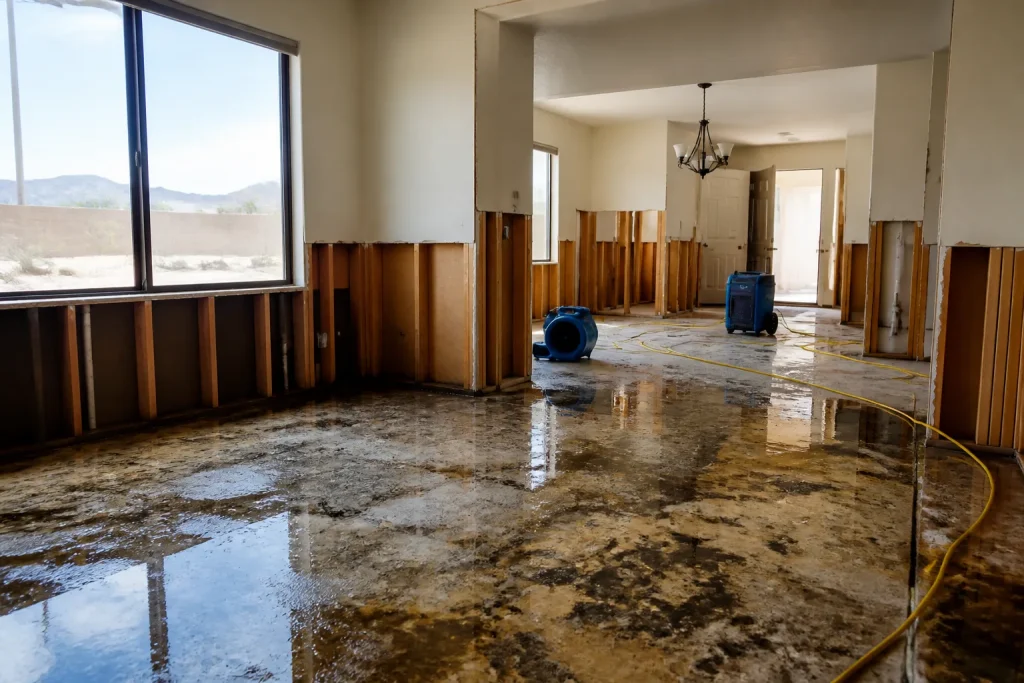
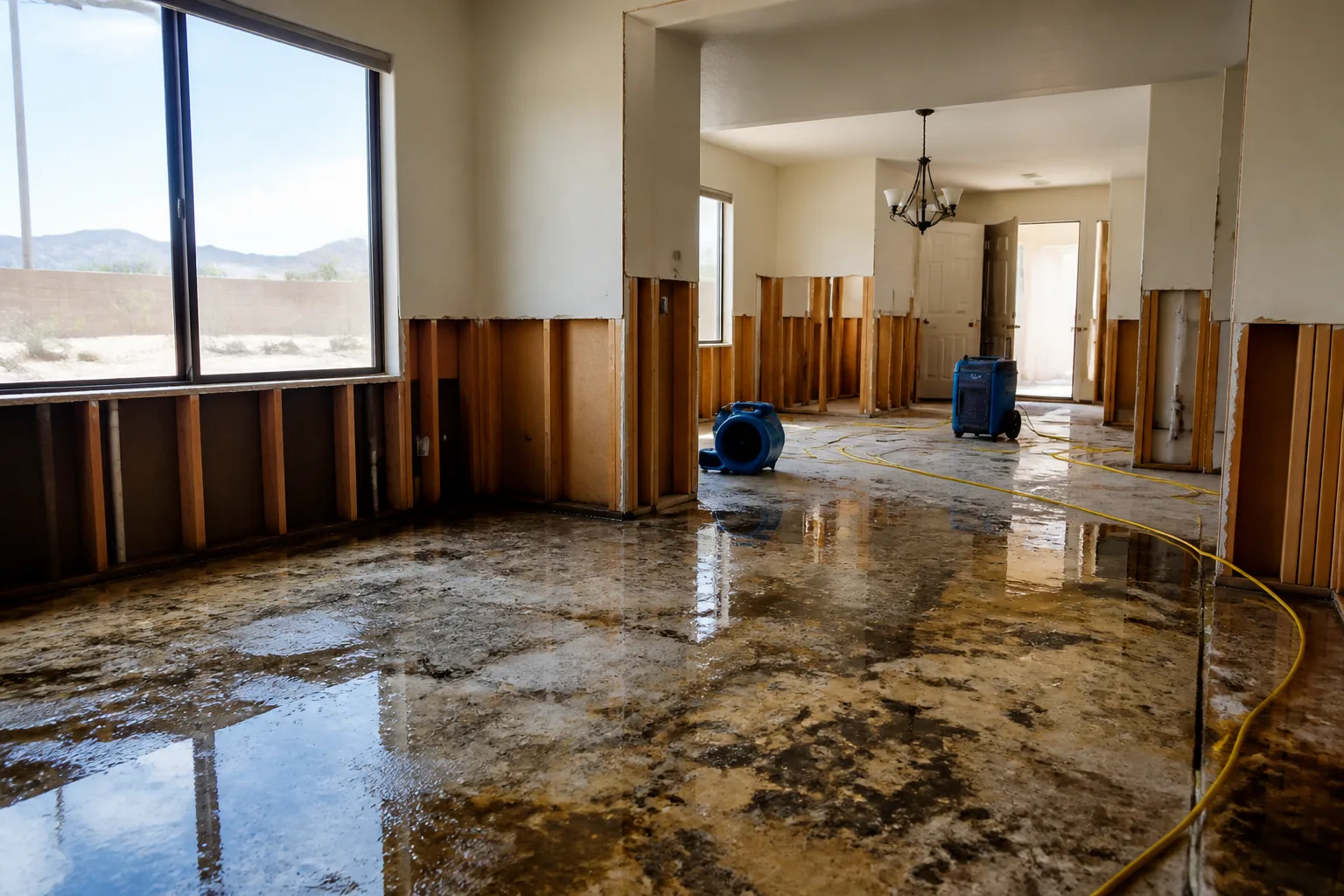
In a wood-frame home, water migrates quickly through stud cavities and evaporates through exterior sheathing. Air movement and heat can dry those structures relatively fast. In block construction, moisture gets trapped between the concrete block and the interior drywall. The concrete itself absorbs water and holds it, releasing it slowly over days or even weeks. If you only measure the drywall surface, you’ll get a false “dry” reading while the block behind it is still saturated.
This is why equipment placement matters more than equipment quantity in Victorville. You need moisture probes inserted into wall cavities, not just surface readings. You need dehumidifiers sized correctly for the cubic footage of the affected space, with attention to the fact that block walls don’t breathe the way frame walls do. And you need patience. Drying a block-construction wall cavity properly often takes five to seven days, sometimes longer, and any contractor who tells you it’ll be done in two is either cutting corners or doesn’t understand the substrate they’re working with.
We use Injectidry cavity-drying systems specifically for this scenario. These units pull air through the void between block and drywall, extracting moisture without requiring us to tear out drywall first. It’s non-invasive structural drying, and in Victorville’s block homes, it’s often the difference between a clean drying job and unnecessary demolition that your insurance may or may not fully cover.
Questions to Ask Before Any Victorville Restoration Crew Places Equipment
Whether you’re evaluating Phoenix, Whitfield Water Damage, or any other restoration contractor in Victorville, these are the questions that separate professional drying science from equipment rental with extra steps:
- “What’s the grain-per-pound capacity of the dehumidifiers you’re placing?” Professional LGR (low-grain refrigerant) dehumidifiers pull 100 to 140 pints per day at AHAM conditions. Conventional refrigerant units pull 50 to 70. In Victorville’s climate, where summer humidity can spike during monsoon season, undersized dehumidifiers extend drying time and increase mold risk.
- “Are you using LGR or conventional dehumidifiers?” LGR units are the industry standard for structural drying. If the answer is “we use what the franchise provides,” ask for the specific model. Dri-Eaz and Phoenix LGR units are what insurance-preferred contractors run in this market.
- “How do you document daily moisture readings?” IICRC-certified drying protocol requires daily moisture content measurements, recorded in writing, with drying goals established before equipment placement. If the technician can’t explain how they’ll document readings, they’re not following the standard.
- “Where exactly are you placing air movers, and why?” Air mover placement should follow a calculated airflow pattern across wet surfaces, not just “put one in each room.” In Victorville block construction, this often means directing air into wall cavities and under toe-kicks, not just aiming fans at the middle of the floor.
- “What’s your drying goal for this structure, and how will you verify it?” A professional answer references equilibrium moisture content of unaffected materials in the same structure. A vague answer about “when it feels dry” is a red flag.
These questions aren’t confrontational. They’re the same questions an insurance adjuster would ask, and any restoration contractor worth their invoice can answer them without hesitation.
What That Authorization Form Actually Commits You To
Every restoration company in Victorville will ask you to sign an authorization form before they start work. Phoenix franchises use them. Whitfield uses them. This is normal and necessary to get the job moving fast. But there’s one clause that deserves your full attention before you sign anything, and it’s called “direction to pay.”
A direction to pay clause tells your insurance company to send payment directly to the restoration contractor. On its face, this sounds convenient. You’re dealing with a flooded house, you don’t want to manage contractor payments, and the insurance company is paying anyway. The problem emerges when there’s a dispute about the quality or completeness of the work.
If your insurance company has already paid the contractor directly, and you later discover that the drying wasn’t done properly or the scope was inflated, your leverage is dramatically reduced. You can’t withhold payment. You’re now arguing with a contractor who already has your money, and your insurance carrier has already closed the claim.
This doesn’t mean you should refuse to sign any authorization form. It means you should read it, understand what you’re committing to, and ask questions before the equipment starts coming off the truck. A restoration company that’s transparent about their authorization terms and willing to explain them in plain English is a restoration company that’s probably transparent about their drying data, too.
We document every drying job to insurance standards specifically because we want adjusters and homeowners to see exactly what was done, when, and why. That documentation protects everyone in the room, and it’s the only honest way to run a restoration operation.
How to Evaluate Any Restoration Company in Victorville
When you’re standing in a flooded living room at 11 p.m. on a Tuesday, researching restoration contractors feels impossible. You want someone there now, and that urgency is exactly why the franchise model exists. But even in an emergency, you can run a quick evaluation framework that takes five minutes and saves you from a six-month headache:
- Certifications: Ask if the technicians are IICRC-certified. This is the restoration industry’s recognized benchmark for training and process standards. A company that holds IICRC certification follows a science-based drying protocol, not guesswork. Phoenix franchises may or may not maintain IICRC credentials depending on the individual owner’s investment in training.
- Professional affiliations: Membership in the Restoration Industry Association (RIA) signals active professional accountability beyond a one-time license. It’s not a guarantee of quality, but it’s a signal that the contractor engages with industry standards rather than operating in isolation.
- Equipment specs: The brands matter because they indicate the contractor’s commitment to professional-grade tools. Dri-Eaz, Phoenix, and B-Air dehumidifiers and air movers are what insurance-preferred restoration contractors run. XPOWER blowers are common in professional fleets. Injectidry systems for cavity drying indicate a contractor who invested in specialized equipment beyond what a rental yard provides.
- Documentation practices: A professional restoration company provides daily moisture readings, a written scope before work starts, and photo documentation throughout the job. If any of these are missing, you’re working with a company that won’t stand behind its drying claims when the adjuster asks questions.
- Post-remediation verification protocol: After drying is complete, how does the company verify the job is actually done? This means final moisture readings at or below the established drying goal, a final visual inspection, and a written completion report. A company that can’t produce this documentation at the end of the job didn’t actually finish the job.
For Victorville homeowners specifically, ask about experience with block-and-stucco construction. A contractor who has only dried wood-frame homes in coastal markets may not understand how moisture behaves in your walls. The difference between a four-day drying job and a seven-day drying job isn’t incompetence. It’s the difference between following the data and forcing the data to fit the schedule.
When to Call a Pro
If the water event involved more than what a single towel session can handle, call a professional restoration company. If water has been sitting for more than 24 hours, call a professional. If you see water staining on baseboards, bubbling drywall, or a musty odor developing, call a professional. If the water came from outside, from a sewage line, or from a refrigerator line that’s been leaking slowly inside the wall for weeks, call a professional immediately. The water you can see is rarely the full extent of the damage, and in Victorville’s block construction, what’s trapped inside the wall cavity is doing more damage than what’s puddled on the floor.
For related services in Victorville, you can read more about our approach to water damage restoration in Jurupa Valley or learn how we handle mold remediation in Jurupa Valley. We also provide fire damage restoration in Jurupa Valley with the same certified team and documentation standards.
The Bottom Line
Phoenix Water Damage Restoration in Victorville is a franchise brand, and like any franchise, the quality of your experience depends heavily on the individual owner running the territory. The brand’s standardized protocols and insurance relationships are real advantages. But Victorville’s block-and-stucco construction demands more than a standardized playbook. It demands moisture readings that account for trapped water in wall cavities, equipment sized correctly for closed-chamber drying environments, and the patience to let the data drive the timeline instead of the equipment rotation schedule.
If you’re in Victorville and need help, Whitfield Water Damage offers free estimates. We run IICRC-certified drying protocols with professional-grade equipment including Dri-Eaz, Phoenix, and B-Air air movers, XPOWER blowers, and Injectidry cavity-drying systems. One certified team handles water, mold, and fire damage, documented to insurance standards from the first moisture reading to the final verification. Call (855) 382-0478 for a free estimate, and if you’d like to learn more about our full range of restoration services, start at our home page or read about our water damage restoration in Jurupa Valley services.
Frequently Asked Questions
In Victorville’s block-and-stucco construction, structural drying typically takes five to seven days, sometimes longer depending on the affected materials and the drying chamber geometry. Wall cavities between block and drywall hold moisture longer than open wood-frame construction, and forcing a shorter timeline increases mold risk. IICRC-certified drying protocol follows daily moisture readings to determine when a structure is actually dry, not a calendar estimate. Call (855) 382-0478 for an assessment specific to your property.
Most homeowner policies cover sudden and accidental water damage, and Phoenix franchises maintain relationships with major insurance carriers. The more important question is how the restoration contractor documents the work. Insurance adjusters rely on daily moisture readings, photo documentation, and a written scope to process claims. A contractor who documents to insurance standards makes the claims process smoother regardless of which brand name is on the truck. Call (855) 382-0478 to discuss your specific policy situation, and if you’re wondering about out-of-pocket costs, read our guide to water damage restoration in Jurupa Valley for more context.
LGR stands for low-grain refrigerant, and these units pull significantly more water from the air than conventional dehumidifiers, typically 100 to 140 pints per day at AHAM conditions versus 50 to 70 for conventional units. LGR units are the industry standard for structural drying because they maintain lower humidity levels in the drying chamber, which accelerates evaporation from wet materials. In Victorville’s seasonal monsoon humidity, undersized conventional dehumidifiers extend drying time and increase mold risk. Professional restoration companies run LGR units from Dri-Eaz or Phoenix as standard equipment.
For small, contained spills on non-porous surfaces, yes. For anything that has saturated drywall, carpet padding, subflooring, or wall cavities, no. The water you can see is typically a fraction of the total, and in Victorville’s block construction, moisture trapped behind drywall will not evaporate with surface airflow alone. It requires cavity-drying systems like Injectidry, calculated air mover placement, and daily moisture readings to verify the structure has actually dried. Incomplete drying leads to mold, and mold remediation is far more expensive than proper drying. That’s not a sales pitch. It’s the same advice we give our own families. Call (855) 382-0478 if you’re unsure whether your situation warrants professional equipment.
Written by the team at Whitfield Water Damage, serving Victorville since 2011.
Need Damage Restoration Help?
Call Whitfield Water Damage — licensed & insured, here with fast after-hours help in Jurupa Valley.
(855) 382-0478