Water Damage Restoration Cost Guide: What Victorville Homeowners Pay in 2026
Most Victorville homeowners will pay between $2,400 and $14,000 for water damage restoration in 2026, with the typical kitchen or bathroom loss landing around $5,800. That range is wide because restoration cost has almost nothing to do with how many square feet got wet and everything to do with what got wet and how long it sat. If you’d rather skip the math and get an exact number, call us at (855) 382-0478 for a free on-site assessment.
The California Average That Misleads Everyone
The average water damage claim in California runs $11,000 to $17,000, and if you Google your situation, that’s the number that’ll pop up first. Here’s the problem: averages hide the two variables that actually drive your bill. A 600-square-foot living room with Category 1 clean-water flooding on top of tile might dry out for $3,200. A 200-square-foot kitchen with a Category 2 dishwasher leak that soaked into the subfloor, wicked up the cabinet bases, and sat for three days could hit $9,800. The difference isn’t square footage. It’s the layers: how far down the water traveled and how contaminated it became before anyone touched it.
In Victorville specifically, you’re also fighting construction realities that don’t exist in coastal California. Homes built between the 1970s and 1990s here are overwhelmingly slab-on-grade, which means water doesn’t just sit on a subfloor you can vent from below. It tends to move laterally through the concrete, migrating into adjoining rooms, under built-ins, and up into wall base plates. That’s why we stress documentation and drying-duration data over quick visual assessments. If a company gives you a quote before they’ve mapped moisture migration with a thermal imager and calibrated moisture meters, they’re guessing.
What Actually Drives Your Water Damage Bill in Victorville
Forget the national averages. Here’s what you’re actually paying for in the High Desert market, line by line. These are 2026 market ranges we see regularly across Victorville, Adelanto, and Hesperia jobs.
- Water extraction: $350 to $1,400 depending on standing-water depth and floor type. Carpet-pad extraction on a saturated bedroom runs lower; standing water over tile with perimeter wicking runs higher.
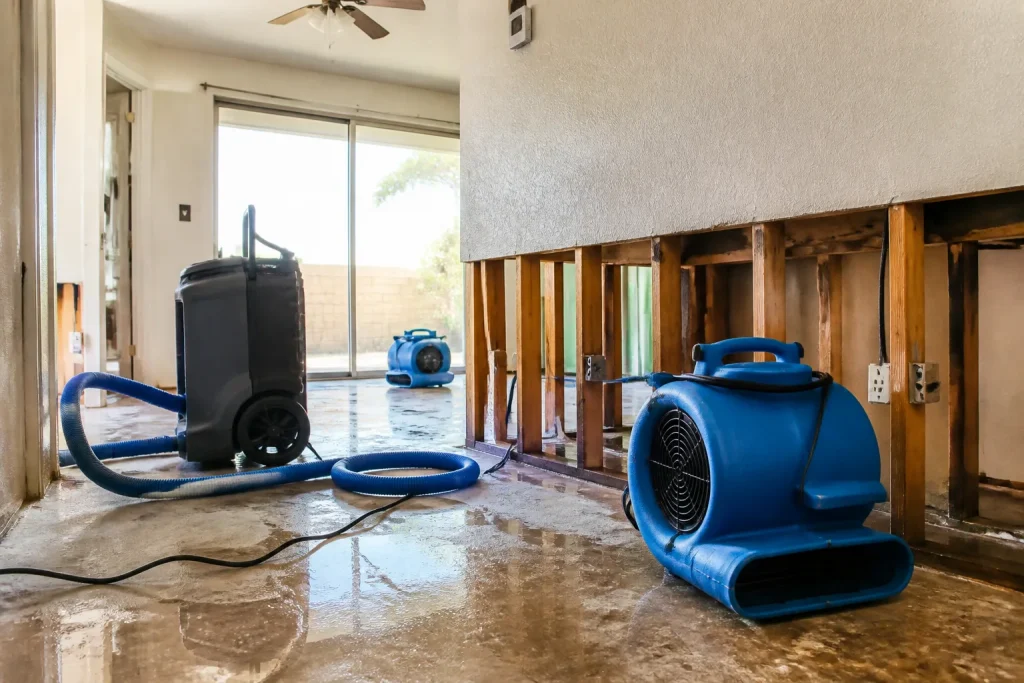
- Structural drying: The real line item. Each professional-grade LGR dehumidifier (we run Dri-Eaz and Phoenix units) costs $85 to $140 per unit per day, and a typical Victorville kitchen needs 4 to 8 air movers plus 3 to 5 LGRs running 3 to 6 days. That’s $1,200 to $3,400 in equipment alone before labor, monitoring visits, and antimicrobial applications.
- Containment and air scrubbing: $450 to $1,800 when you’re dealing with Category 2 or 3 water, because you need negative air pressure and physical barriers to prevent cross-contamination into the rest of the house.
- Baseboard and drywall removal: $1.50 to $3.50 per linear foot for base; $2.00 to $4.50 per square foot for drywall depending on height of the wet line and whether it’s insulated.
- Antimicrobial and anti-fungal treatment: $300 to $1,100. This is not optional in High Desert summers, where interior temperatures accelerate mold colonization within 24 to 48 hours after a loss.
- Content pack-out and off-site drying: $800 to $4,500 if you have furniture, rugs, clothing, or electronics affected. On-site content drying with focused air movers can cut this by 40 to 60 percent.
- Flooring removal and reinstallation: Carpet and pad replacement runs $4 to $9 per square foot installed; engineered wood replacement $9 to $18; tile removal and reset $12 to $25 depending on substrate repair.
One line item most Victorville homeowners don’t expect: concrete slab drying. When water sits on a slab foundation, moisture migrates into the concrete and can take 7 to 21 days to fully release. That means equipment stays running longer, monitoring visits continue for weeks, and if you skip that phase, your new flooring will fail within 6 to 18 months. A cheap bid that skips slab-drying verification is not a deal. It’s a foundation for a second claim.
Why Every 24 Hours You Wait Adds Real Money
Water loss classification isn’t static. A Category 1 loss, which starts as clean water from a supply line or overflowing sink, begins transitioning toward Category 2 within 24 to 48 hours as it picks up dissolved organic matter, bacteria from flooring and drywall, and anything else in its path. Category 2 water is contaminated enough to require antimicrobial treatment, biocides, and more aggressive disposal of porous materials. Category 3, which is what you get with sewage backup or prolonged standing water that’s gone microbially active, requires full PPE protocols, controlled disposal, and dramatically higher per-square-foot costs.
In practical terms: a water loss that could’ve been mitigated for $2,800 on day one can become a $7,500 loss on day four. The difference isn’t extra labor hours; it’s that materials that could be saved now have to be removed, and materials that could be cleaned now need to be treated. Those additional treatment and disposal fees usually land in the $2,000 to $6,000 range depending on affected square footage and content.
We pulled a job out of a garage over in the Brentwood area of Victorville last month where a water heater had been slowly leaking for almost a week before the homeowner noticed the drywall staining. It started as a simple supply line leak, Category 1. By the time we got there, the moisture had run under the slab lip, into the shared wall with the living room, and up into the bottom six inches of drywall on both sides. What could’ve been a $2,200 extraction-and-dry job became a $6,800 reconstruction project because the base plates had to come out. The water didn’t do more damage because it was special water. It did more damage because it had seven extra days.
When the Equipment Brand Actually Matters
Here’s where most homeowners get oversold or undersold: restoration is equipment-driven, but not all drying equipment is the same. The IICRC-certified protocol we follow specifies target airflow per square foot of affected surface, target grain-depression levels based on ambient conditions, and daily moisture-content readings that must show measurable drying progress. Hitting those numbers in a High Desert summer, when your indoor humidity is already low but your slab temps are pulling moisture up from below, takes real drying horsepower.
We run a curated fleet of Dri-Eaz and Phoenix LGR dehumidifiers, XPOWER air movers, and B-Air units, the same brands any insurance-preferred contractor in Southern California runs. The difference isn’t the logo. It’s the monitoring schedule. An LGR that runs unmonitored for four days is just a rental. An LGR with daily grain-depression logs, moisture-content readings at marked penetrations, and a documented drying curve is a restoration plan. When you’re comparing bids in Victorville, ask who’s monitoring the equipment and how often. If the answer is “we’ll be back in a few days,” keep calling.
Insurance Coverage in Victorville: What’s Covered, What’s Not, and What Gets Claims Denied
Most standard San Bernardino County homeowner policies cover sudden and accidental water damage: a burst supply line, a failed water heater, an overflowing washing machine, storm-driven roof leaks. What they typically exclude is gradual damage, which is the phrase adjusters use for the slow leak behind the sink cabinet that’s been rotting the baseboard for six months. The maintenance carve-out is real, and it’s the number one reason water damage claims get denied in the High Desert.
Here’s what we tell Victorville homeowners about the claims process, based on the documentation adjusters actually need:
- Take photos before anything moves. Standing water, wet drywall lines, baseboard separation, and the source area. Your adjuster will never see the water as it sat, so your photos are the evidence file.
- Document the source. A failed supply line has a date stamp when you bought it. A corroded water heater has a serial number and install date. If there’s a manufacturing defect, that matters for subrogation, and the carrier recovers their payout from the manufacturer.
- Get a professional moisture map. The single highest-value document in any dispute is a professional moisture survey showing affected materials, measured moisture levels, and drying-duration projection. It’s hard for an adjuster to argue with calibrated instruments and an IICRC-certified protocol when the numbers line up.
- Don’t wait for the adjuster to show up before you start mitigation. Every policy has a duty-to-mitigate clause. You’re expected to prevent additional damage while you wait. That means stopping the source, removing standing water when safe, and getting professional drying started. Waiting for an adjuster visit three days out is how homeowners end up in Category 2 territory with a claim that now has to cover more than it should.
If you’re working through a claim, ask your restoration contractor how they document. We document every job to insurance standards, which means photo logs, moisture-content readings at marked locations, daily drying-log entries, and a final scope report that an adjuster can pass straight through an Xactimate review without getting held up. That matters because an adjuster who can read your file in ten minutes is an adjuster who’s more likely to approve your supplements on the first pass.
How to Read an Xactimate Estimate Without a License
Xactimate is the estimating software most insurance carriers and restoration companies in San Bernardino County use, and if you’ve never stared at a 14-page line-item estimate, it looks like a tax return written in code. Here’s how to decode the parts that matter to your payout.
Line codes tell you what’s being done, not just what it costs. WTR EXTR means water extraction. WTR DRY means structural drying, usually followed by a per-day or per-unit line item. ANTIMIC means antimicrobial application. PACK, MOVE, and CONT are content pack-out, content manipulation, and content cleaning codes. If you don’t see a WTR DRY line with a per-unit-per-day structure, your mitigation estimate is incomplete.
Ask about the “dehumidifier per day” line count. Xactimate prices equipment based on the number of units and the number of days they’re expected to run. A three-day drying estimate with four LGRs looks different from a five-day estimate with six LGRs, and the higher number isn’t padding if the moisture map says the slab is holding water. If your contractor can’t walk you through why your job needs the unit count and day count it does, ask them to pull the moisture log. They should have one.
Check for “remove and replace” versus “dry in place.” This is the biggest dollar swing in most estimates. Removing and replacing drywall, baseboard, and flooring is expensive. Drying in place using non-invasive structural drying, like Injectidry cavity-drying systems that pull water out of wall cavities and under flooring without demolition, costs a fraction of the rebuild price. Not every situation qualifies for dry-in-place, but if your contractor never mentions it as an option, they may be defaulting to the more expensive tear-out scope, which is also more disruptive to your life.
One more thing to check: look for a line item for monitoring. If the estimate has equipment and no daily monitoring visits, or monitoring is bundled into a flat fee with no visit count, the vendor is telling you they won’t be checking the equipment. Equipment without monitoring is how you find out three weeks later that your slab never reached its drying target.
What a Real Victorville Restoration Project Looks Like, Step by Step
Here’s the process we follow when a homeowner in Victorville calls us at 7 p.m. because a water line let go inside a wall. Knowing this sequence helps you evaluate any contractor’s plan before you sign.
- 1
Source stop and safety check. Shut off the water, kill power to affected circuits, and confirm there’s no electrical hazard. This is free, fast, and does not wait for a signed work order.
- 2
Moisture mapping. Thermal imaging and calibrated moisture meters map the affected area. We mark readings at baseboards, subfloor penetrations, and inside wall cavities. This map defines the scope and the equipment plan.
- 3
Extraction. Professional-grade extraction pulls standing water from carpet, pad, and hard surfaces. High-pressure extraction from tile and concrete surfaces matters more than most people think, because water left in grout lines and concrete pores extends drying time.
- 4
Containment and air movement. Physical barriers and negative-air containments keep contamination from spreading, while air movers and LGRs start pulling moisture from materials into the air and out of the house.
- 5
Application of antimicrobials where the category protocol requires it. Category 2 and 3 losses in Victorville’s summer heat need this step done promptly.
- 6
Daily monitoring and adjustment. Equipment placement shifts as drying progresses, and moisture logs tell us when areas are drying and when they’re not. The goal is reaching the documented drying standard, not running equipment a fixed number of days.
- 7
Scope for reconstruction. Once the affected areas meet dryness standards, we document what needs to go back: baseboard, drywall, paint, flooring, and insulation where applicable. That scope is written in advance, priced in writing, and agreed to before any rebuild starts.
The Whitfield Water Damage home team handles the full sequence in-house, from initial mitigation through reconstruction scope. That means no handoff to an unfamiliar crew when the job moves from the drying phase to the rebuild phase.
The Bottom Line
Water damage restoration in Victorville in 2026 is priced by water category, affected material layers, equipment density, and drying duration, not by square footage. The average California claim figure of $11,000 to $17,000 is real but almost useless for budgeting your specific situation. What matters is how deep the water went, how long it sat, and whether your contractor is running a documented IICRC-certified drying protocol with professional-grade equipment and daily monitoring. If you’re in Victorville and need help, Whitfield Water Damage offers free assessments, and we’ll give you a straight answer about what needs to be done and what it’ll cost. Call (855) 382-0478.
Frequently Asked Questions
How much does water damage restoration cost in Victorville in 2026? Most Victorville homeowners pay between $2,400 and $14,000, with typical kitchen or bathroom losses around $5,800. Costs depend on water category, affected material layers, and drying duration more than square footage. Call (855) 382-0478 for an exact quote, estimates are free.
Does homeowners insurance cover water damage restoration in Victorville? Most San Bernardino County policies cover sudden and accidental damage like burst supply lines or failed water heaters, but exclude gradual damage from long-term leaks under maintenance clauses. Documentation with photos, moisture maps, and daily drying logs significantly reduces claim denial risk.
How long does water damage restoration take in Victorville? Extraction happens in the first day; structural drying with professional LGR equipment typically runs 3 to 6 days; slab drying can continue for 7 to 21 days depending on substrate conditions; and reconstruction depends on scope, often 2 to 8 weeks from dry-out to final paint.
Can I dry out water damage myself with fans and a dehumidifier? Residential fans and consumer dehumidifiers lack the grain-depression capacity and airflow density to dry structural materials like drywall, baseplate lumber, and concrete slabs to a verified standard. Hidden moisture left in wall cavities or under flooring leads to mold and secondary damage. For safety and liability reasons, professional structural drying with calibrated monitoring is the standard we recommend, not a DIY project.
Written by the team at Whitfield Water Damage, serving Victorville since 2011.
Need Damage Restoration Help?
Call Whitfield Water Damage — licensed & insured, here with fast after-hours help in Jurupa Valley.
(855) 382-0478